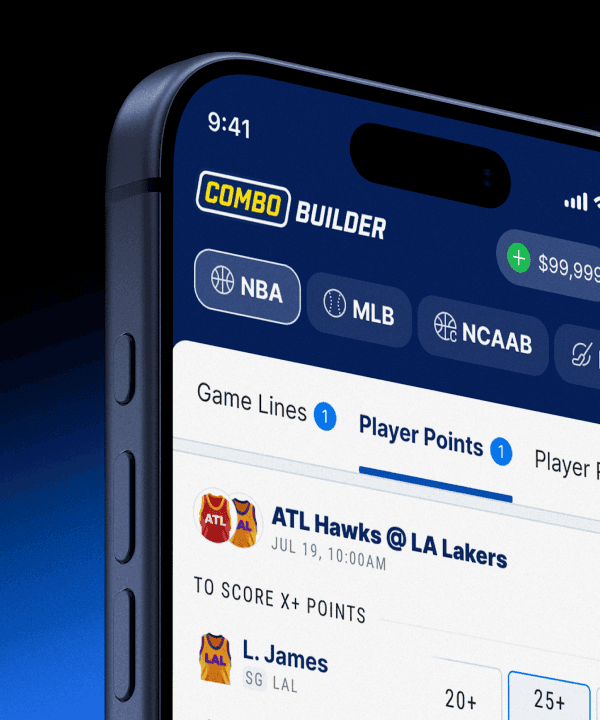
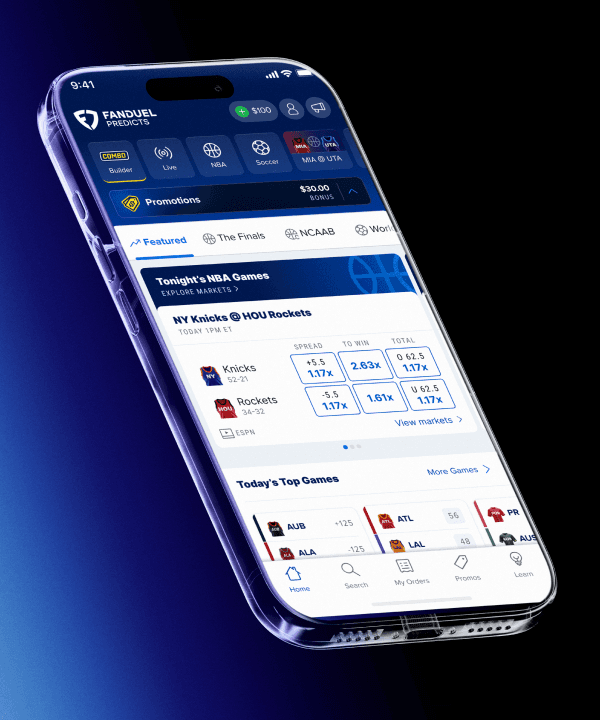
Combo Builder
FanDuel Predicts is a prediction market for sports. People trade on outcomes against each other instead of betting against the house. The Combo Builder lets them stack a few predictions into one trade with a single larger payout, basically the prediction-market version of a parlay.
2026
YEAR
Design Lead
ROLE
AT A GLANCE
Problem
Parlays drive most of the revenue in sports betting, but Predicts launched without them. I had to bring them to a peer-to-peer prediction market where a regulatory rule quietly blocked the way people are used to building them.
Approach
I turned that constraint into the structure of the product: a focused builder that only ever shows markets you can combine, with stat-first navigation matched to how people really build prop parlays. Scoped in two phases to protect the deadline.
Outcome
Tested with 12 users across three segments, then shipped as a 0-to-1 feature with player props included, from a two-week proof of concept and on time for the World Cup.
CONTEXT
The Opportunity
FanDuel Predicts is a prediction market for sports. People trade on outcomes against each other instead of betting against the house. Combos let them stack a few predictions into one trade with a bigger combined payout, the same idea as a parlay in sportsbook.
Predicts didn't have them yet. Adding them meant bringing the single most valuable thing in sports betting to a new product space. When a competitor moved into the same space, it jumped to the top of the list, and I had two weeks to get a proof of concept solid enough for engineering to start building right away.
70%
OF SPORTSBOOK REVENUE COMES FROM PARLAYS (COMBOS)
$44B
TRADED ON PREDICTION MARKETS IN 2025
$2.5B
PROJECTED TO TRADE DURING THE 2026 WORLD CUP
THE CONSTRAINT
The rule that shaped everything
Predicts runs on two separate regulated exchanges — one for game lines (moneyline, spread, totals), one for player props. You can't combine markets across them in a single trade. In the sportsbook people already know, you can mix almost anything. Here you can't — and users have no idea the boundary exists.

TWO EXCHANGES, NO CROSSING
THE APPROACH
Phasing under uncertainty
One question was open at kickoff: would both game-line and player-prop markets be ready for launch? we couldn't let that block a top-priority release, so I split the work in two — Phase 1 (game lines) as a complete, shippable version, and Phase 2 (player props) designed in parallel, ready to pull forward the moment those markets were ready. Engineering ended up onboarding player props early, so we shipped Phase 2 into launch — which was a clean expansion instead of a scramble.
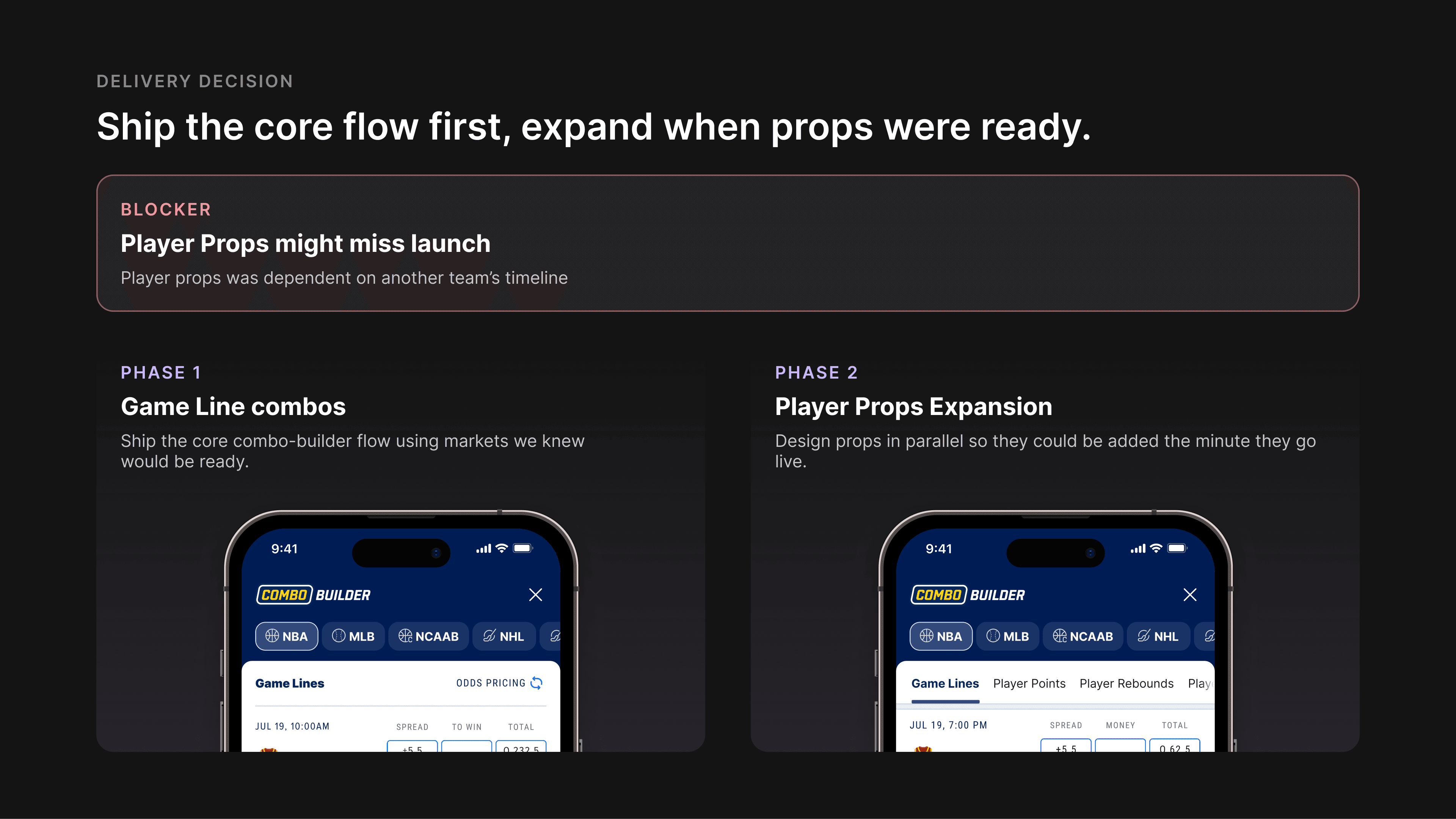
PHASE 1 SHIPS ALONE. PHASE 2 READY TO PULL FORWARD
THE DECISION
Why player props changed the navigation
84%
OF PARLAYS CONTAIN PLAYER PROPS
A game-first structure (pick a game, then its markets) works for same-game parlays, but it hides how people actually build prop combos — which starts from a stat and pulls it across the whole slate. So I led with a stat-first architecture: choose the stat first, then narrow to games and markets. A real tradeoff against the more familiar pattern — the behavior data is what made me confident.

STAT-FIRST VS GAME-FIRST
EXPLORATION
From "combo anywhere" to a contained builder
I looked at two directions.
Combo from anywhere mirrored the sportsbook — start a combo from any market. Most familiar, but it walked straight into the constraint: people would constantly hit markets that can't combine, with no idea why.
A contained Combo Builder — a focused space that only ever surfaces combinable markets — defines what's possible up front instead.

REJECTION VS SHIPPED
The contained builder turns the constraint into structure instead of friction. Since it only ever shows combinable markets, the worst failure case simply can't happen. There's no error to recover from, because you can't get into that state.
SOLUTION
What I built
The Combo Builder lets people find combinable markets, stack picks, and watch the multiplier update live. Familiar enough that sportsbook users need no instructions; structured enough that the exchange boundary never surfaces as a problem.
Live build feedback. Add a pick and the combo title and multiplier update in real time — the growing payout stays the thing you notice. I designed the motion so each added leg feels responsive.
Edge cases, handled honestly. With cross-exchange mixing designed out, only the logical cases remain — overlapping picks, conflicting outcomes, the six-leg max, the payout cap — each with a clear state and a scannable rules modal.
ADDING PICKS UPDATES THE COMBO TITLE AND MULTIPLIER IN REAL TIME

EACH LOGICAL ERROR GETS A CLEAR STATE, BACKED BY A SCANNABLE RULES MODAL.
VALIDATION
What testing proved — and changed
One thing I'll be straight about: even with the added education, sportsbook users still tended to experiment their way through errors — the same trial-and-error habit they bring from the sportsbook. We shipped the clarity fixes and left that as an open question rather than pretending we'd solved it.
WHAT THE DESIGN GOT RIGHT
People correctly guessed the combo-building steps before tapping anything — the flow matched the mental model they walked in with.
Across all three error scenarios, they spotted the problem and knew the fix was to remove a selection.
WHAT TESTING CHANGED
Made the limits explicit. The app told people what to do next but never stated the actual max amount of selections, so they found them by trial and error — many re-triggered the max-legs error two or more times just to keep reading the message. We put the exact limits in the rules and let the error message open them directly.
Tightened the error path. Clearer messaging and an easier route into the rules, so the fix isn't something you stumble into.

IMPACT
What shipped, and what's next
Shipped a 0-to-1 feature on a compressed timeline, from a two-week proof of concept to launch, in time for the World Cup.
Validated with users across three segments before build, then iterated on what they showed us.
Pulled player props into the launch instead of a later release, and raised the limit to six legs, so the most valuable markets were there on day one.
Moved faster by reusing components I'd already built for another team, which is a big part of how one designer shipped something this size in time.
OUTCOME METRICS - FIRST 3 WEEKS OF WORLD CUP
1 in 3
OF ACTIVE USERS PLACED A COMBO
50%
ORDER CONVERSION FROM BUILDER
19%
OF ALL TRADES WERE COMBOS
REFLECTION
What I took from it
A hard constraint can be a better starting point than a blank page. The exchange rule could have been the thing we couldn't do. Looked at another way, it became the organizing idea for a more focused, easier-to-read combo experience than "parlay from anywhere" would ever have been, one where the worst mistake just isn't possible.
I also got a lot out of designing for uncertainty instead of fighting it. Phasing the work let me protect a deadline I couldn't move and still be ready to grab the better scope the second it was available. When player props came in early, we shipped them instead of retrofitting them later.